
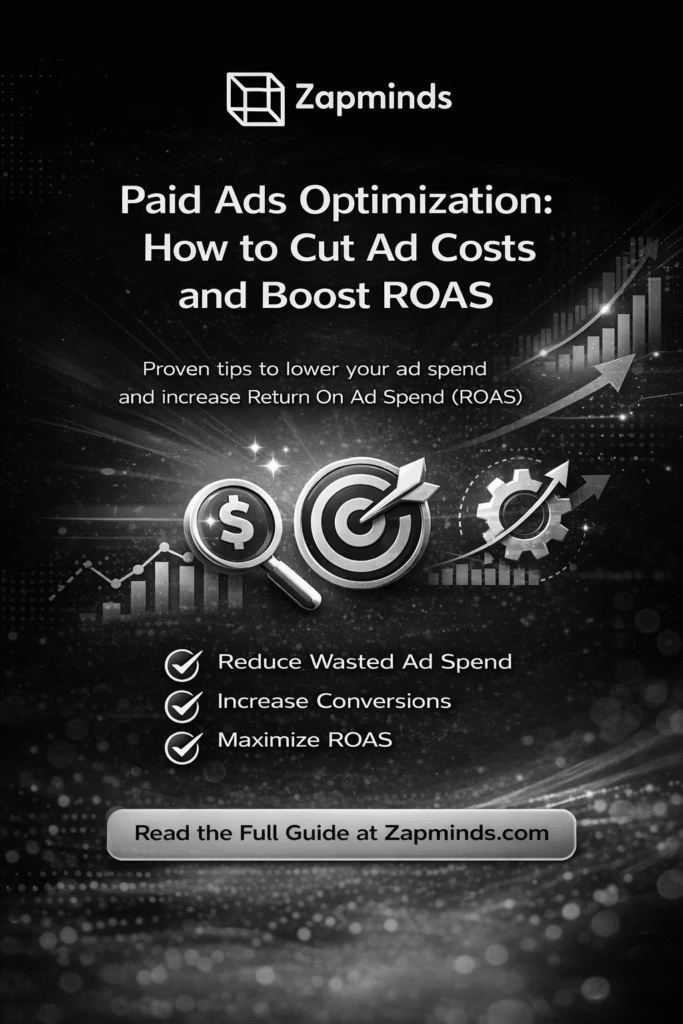
Paid Ads Optimization is very important for businesses that want to grow without spending more on marketing.
To succeed you must do more than just run ads.
You need to make your ads work better save money and get value for every dollar spent.
If your business uses Google Ads, Meta Ads or other paid advertising platforms but has rising costs and uneven results
this guide will help you improve performance while keeping ad costs under control.
Why Paid Ads Optimization Matters More Than Ever
Digital advertising costs continue to rise across platforms. Increased competition, audience saturation, and algorithm changes make it harder to maintain profitability. This is where Paid Ads Optimization: How to Cut Ad Costs and Boost ROAS becomes essential.
Without proper optimization:
- Cost per click (CPC) increases
- Cost per acquisition (CPA) rises
- Conversion rates drop
- Budget gets wasted on low-intent traffic
With the right optimization strategies, however, businesses can:
- Reduce wasted ad spend
- Improve targeting accuracy
- Increase conversion rates
- Scale revenue without increasing budget
Step 1: Audit Your Current Campaign Performance
Before you cut ad costs, you must identify where money is being wasted.
Start by analyzing:
- Campaign-level ROAS
- Ad group performance
- Keyword or audience-level results
- Conversion rates
- Cost per conversion
Look for:
- High-spend, low-conversion campaigns
- Underperforming keywords
- Broad targeting with low engagement
- Poor-performing ad creatives
Paid Ads Optimization: How to Cut Ad Costs and Boost ROAS begins with eliminating inefficiencies. Pause what is not working before scaling what is.
Step 2: Refine Audience Targeting
One of the biggest reasons ad costs increases is poor targeting.
Instead of targeting broad audiences:
- Use custom audiences
- Create lookalike audiences
- Retarget website visitors
- Segment by behavior and intent
For example:
- Retarget cart abandoners
- Exclude existing customers
- Focus on high-value segments
Better targeting reduces wasted impressions and increases conversion rates, which directly improves ROAS while lowering cost per acquisition.
Step 3: Improve Ad Creative and Messaging
Ad fatigue is real. When users repeatedly see the same ad, engagement drops and CPC increases.
To improve performance:
- Test multiple ad variations
- Refresh creatives every 30–45 days
- Use strong hooks in the first 3 seconds
- Highlight clear benefits, not just features
- Include compelling calls-to-action
A/B testing headlines, visuals, and ad copy helps identify high-performing combinations. Even a small increase in click-through rate (CTR) can significantly lower cost per click and improve overall campaign performance.
Step 4: Optimize Landing Pages for Conversions
Many advertisers focus only on ads and forget about the landing page experience.
If your landing page:
- Loads slowly
- Has unclear messaging
- Lacks trust signals
- Has weak CTAs
You will struggle to boost ROAS regardless of targeting.
Paid Ads Optimization: How to Cut Ad Costs and Boost ROAS requires alignment between ad messaging and landing page content. Ensure:
- Clear headline matching the ad promise
- Strong value proposition
- Social proof and testimonials
- Fast loading speed
- Simple, focused call-to-action
Improving conversion rate reduces cost per acquisition without increasing ad spend.
Step 5: Use Smart Bidding Strategies
Platforms like Google Ads offer automated bidding strategies such as:
- Target ROAS
- Maximize conversions
- Target CPA
- Enhanced CPC
Instead of manually adjusting bids without data, use smart bidding once sufficient conversion data is available.
However, monitor performance carefully. Automation works best when supported by proper tracking and consistent optimization.
Step 6: Eliminate Waste with Negative Keywords
In Google Ads campaigns, negative keywords are powerful for reducing wasted budget.
For example:
If you sell premium software, exclude keywords like:
- Free
- Cheap
- Download free version
Negative keywords ensure your ads don’t show for irrelevant searches, which improves click quality and boosts ROAS.
Paid Ads Optimization: How to Cut Ad Costs and Boost ROAS often improves dramatically after cleaning up search queries.
Step 7: Focus on High-Intent Traffic
High-intent users convert better and cost less in the long run.
Examples of high-intent signals:
- “Buy now”
- “Pricing”
- “Best software for business”
- “Service near me”
Instead of chasing traffic volume, focus on purchase-ready users.
High-intent campaigns may have slightly higher CPC, but they often produce better ROAS and lower CPA.
Step 8: Monitor Frequency and Ad Fatigue
If your audience sees your ad too often, performance declines.
Monitor:
- Frequency score
- CTR trends
- Engagement rates
When performance drops:
- Rotate creatives
- Expand audience
- Refresh messaging
Ad fatigue increases costs unnecessarily. Regular creative refreshes help maintain performance stability.
Step 9: Track Micro-Conversions
Many businesses only track final purchases.
Instead, track:
- Add to cart
- Sign-ups
- Video views
- Form submissions
- Scroll depth
Micro-conversion tracking provides more optimization data and helps platforms optimize campaigns more effectively.
Paid Ads Optimization: How to Cut Ad Costs and Boost ROAS improves significantly when data-driven decision-making replaces guesswork.
Step 10: Scale What Works, Cut What Does not
Optimization is not about constant change; it is about strategic scaling.
Once you identify:
- High-performing audience segments
- Top-converting creatives
- Profitable keywords
Gradually increase budget on winning campaigns while maintaining efficiency benchmarks.
Avoid sudden budget increases that can disrupt algorithm learning.
Common Mistakes That Increase Ad Costs
To fully understand Paid Ads Optimization: How to Cut Ad Costs and Boost ROAS, avoid these mistakes:
- Scaling too quickly
- Ignoring conversion tracking errors
- Running broad targeting without segmentation
- Not refreshing creatives
- Neglecting landing page optimization
- Focusing only on traffic instead of conversions
Consistency and analysis drive long-term ad success.
Final Thoughts
Paid Ads Optimization: How to Cut Ad Costs and Boost ROAS is not a one-time fix. It is an ongoing process of testing, refining, and improving.
Businesses that win in digital advertising:
- Analyse data regularly
- Focus on conversion rate optimization
- Prioritize audience intent
- Reduce wasted spend
- Align ads with landing pages
When done correctly, you don’t need a bigger budget to grow. You need smarter strategy.
If your goal is sustainable growth, higher profitability, and better campaign performance, start implementing these optimization strategies today.
Because in performance marketing, efficiency is everything.