
Google Search has entered a new era. In 2026, rankings are no longer driven by keywords alone they are shaped by artificial intelligence, user intent, contextual understanding, and experience-driven signals. With Google’s AI-powered search models becoming more advanced, brands that rely on outdated SEO tactics are already seeing traffic decline, while those adapting to AI-first optimization are gaining a competitive edge.
In this blog, we will break down how Google’s AI Search impacts rankings in 2026, what is changed, what still matters, and how businesses can future-proof their SEO strategy in an AI-dominated search landscape.
Understanding Google’s AI Search in 2026
Google’s AI search is no longer an enhancement it is the foundation. Systems like RankBrain, BERT, MUM, and Search Generative Experience (SGE) now work together to understand:
- Search intent beyond keywords
- Context across multiple queries
- Content depth and credibility
- User satisfaction signals
Instead of matching pages to keywords, Google’s AI evaluates whether your content truly solves the user’s problem.
This means rankings are determined by relevance, usefulness, and experience not just optimization tricks.
Key Changes in Google’s AI Search Algorithm
1. Search Is Intent-First, Not Keyword-First
In 2026, Google prioritizes why a user is searching, not just what they typed.
For example:
- “Best digital marketing agency”
- “Who can grow my online sales?”
Google’s AI understands these queries may have the same intent and surfaces content accordingly.
Impact on rankings:
Pages optimized only for exact-match keywords struggle, while intent-aligned, topic-rich content ranks higher.
2. AI-Generated Search Answers Reduce Clicks
With AI-powered summaries appearing at the top of search results, users often get answers without clicking any website.
This has led to:
- Fewer but more qualified clicks
- Higher importance of brand visibility
- Greater value for content cited by AI
Impact on rankings:
Ranking #1 is no longer enough. Your content must be AI-citable, authoritative, and structured for AI understanding.
3. Content Depth Matters More Than Length
Google’s AI evaluates:
- Completeness of information
- Original insights
- Topical authority
- Clear structure and flow
Thin, repetitive, or generic content even if long fails to perform.
Impact on rankings:
Well-researched, experience-backed content outranks keyword-stuffed blogs every time.
4. EEAT Signals Are Stronger Than Ever
EEAT (Experience, Expertise, Authoritativeness, Trustworthiness) is no longer optional.
Google’s AI now evaluates:
- Author credibility
- Brand reputation
- Consistency across platforms
- Trust signals (reviews, mentions, citations)
Impact on rankings:
Brands with clear expertise and proven authority dominate competitive keywords.
5. User Experience Is a Ranking Multiplier
AI search closely monitors how users interact with your website:
- Time spent on page
- Scroll depth
- Bounce rate
- Conversion actions
A page that ranks but fails to engage users will quickly lose visibility.
Impact on rankings:
SEO and CRO are now inseparable. Performance matters as much as content.
What No Longer Works in AI-Driven SEO
In 2026, many traditional SEO tactics are ineffective or risky:
- Keyword stuffing
- Mass AI-generated content with no human insight
- Backlinks from irrelevant sources
- Clickbait headlines with poor content
- Optimizing only for bots, not users
Google’s AI is designed to detect manipulation and reward genuine value.
What Actually Improves Rankings in 2026
1. Topic Clusters Over Single Keywords
AI favours websites that demonstrate topical authority.
Instead of one blog on “SEO,” successful brands create:
- Core pillar pages
- Supporting in-depth articles
- Internal linking between related topics
This signals expertise and improves rankings across multiple queries.
2. Human + AI Content Strategy
AI helps with:
- Research
- Structure
- Data analysis
But human expertise adds insight, originality, and context.
At ZapMinds, we recommend:
- AI-assisted research
- Human-led strategy and storytelling
- Data-backed optimization
This balance wins in AI search.
3. Structured Content for AI Understanding
Google’s AI reads content structurally:
- Clear headings (H1–H4)
- Bullet points and lists
- FAQs and schema markup
- Logical flow
Well-structured pages are easier for AI to interpret and reference.
4. Brand Signals & Authority Building
AI search rewards recognizable, trusted brands.
Ways to build authority:
- Consistent publishing
- Mentions on credible platforms
- Strong social presence
- Clear service positioning
SEO in 2026 is as much about brand building as optimization.
5. Performance-Driven Optimization
Modern SEO goes beyond rankings:
- Conversion tracking
- Heatmaps & behavior analysis
- Continuous content optimization
Google’s AI favors websites that deliver real value and measurable outcomes.
How Google’s AI Search Changes SEO Strategy
SEO is no longer a standalone tactic. It’s part of a larger ecosystem that includes:
- Content strategy
- UX & CRO
- Analytics
- Brand positioning
- Performance marketing
Businesses that align these elements outperform those focused only on rankings.
What This Means for Businesses in 2026
If your SEO strategy hasn’t evolved, you may already be losing visibility.
To stay competitive, brands must:
- Optimize for intent, not keywords
- Create content for humans first
- Focus on authority and trust
- Improve on-site experience
- Use data to guide decisions
This is where expert-led, data-driven agencies like ZapMinds help businesses adapt and grow.
Final Thoughts
Google’s AI search in 2026 rewards clarity over complexity, value over volume, and experience over shortcuts.
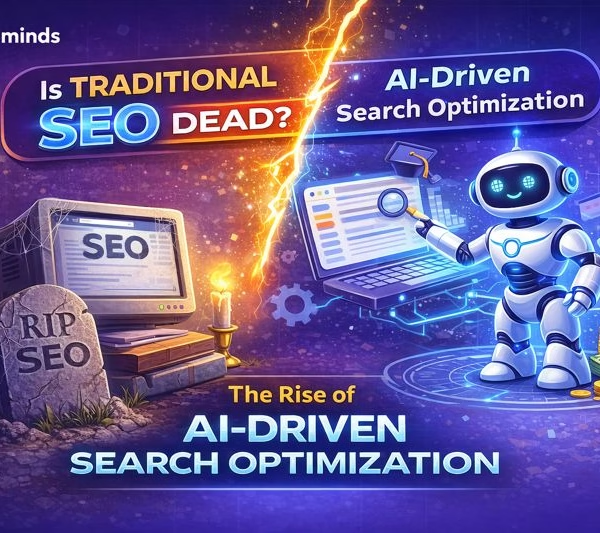
SEO is not dead but traditional SEO is no longer enough.
Brands that understand how Google’s AI evaluates content, experience, and trust will continue to rank, convert, and scale while others struggle to stay visible.
If you are ready to build an AI-ready SEO strategy that actually drives performance, now is the time to evolve.